.png)





How Indian D2C Brands Are Using AI in Branding and Packaging Design (2026)
AI tools can now generate 40 packaging concepts in two hours. Most of them look the same. That is the tension at the centre of every conversation about AI and branding in 2026: the tools have gotten fast enough to be genuinely useful, and generic enough to be genuinely dangerous if a founder treats output as a finished decision.
For Indian D2C (direct-to-consumer, meaning a brand selling straight to shoppers rather than through a separate retailer) brands, the stakes are specific. Your packaging needs to perform on a Blinkit thumbnail (the small square image a product shows in a scrolling app grid), earn a retail buyer's confidence in a first meeting, and build enough visual recognition that a returning customer finds you on a BigBasket grid without reading your name. AI can accelerate the process of getting there, but it cannot decide where "there" is, since that is a positioning decision and positioning is still entirely human work.
This article covers the five AI trends reshaping D2C branding and packaging in India right now, what the strongest brands are doing differently, and a practical framework for using AI without losing the brand identity that makes your packaging worth recognising in the first place. The patterns hold across skincare, food, and wellness brands alike, not just beauty.
What Is AI in Branding and Packaging Design?
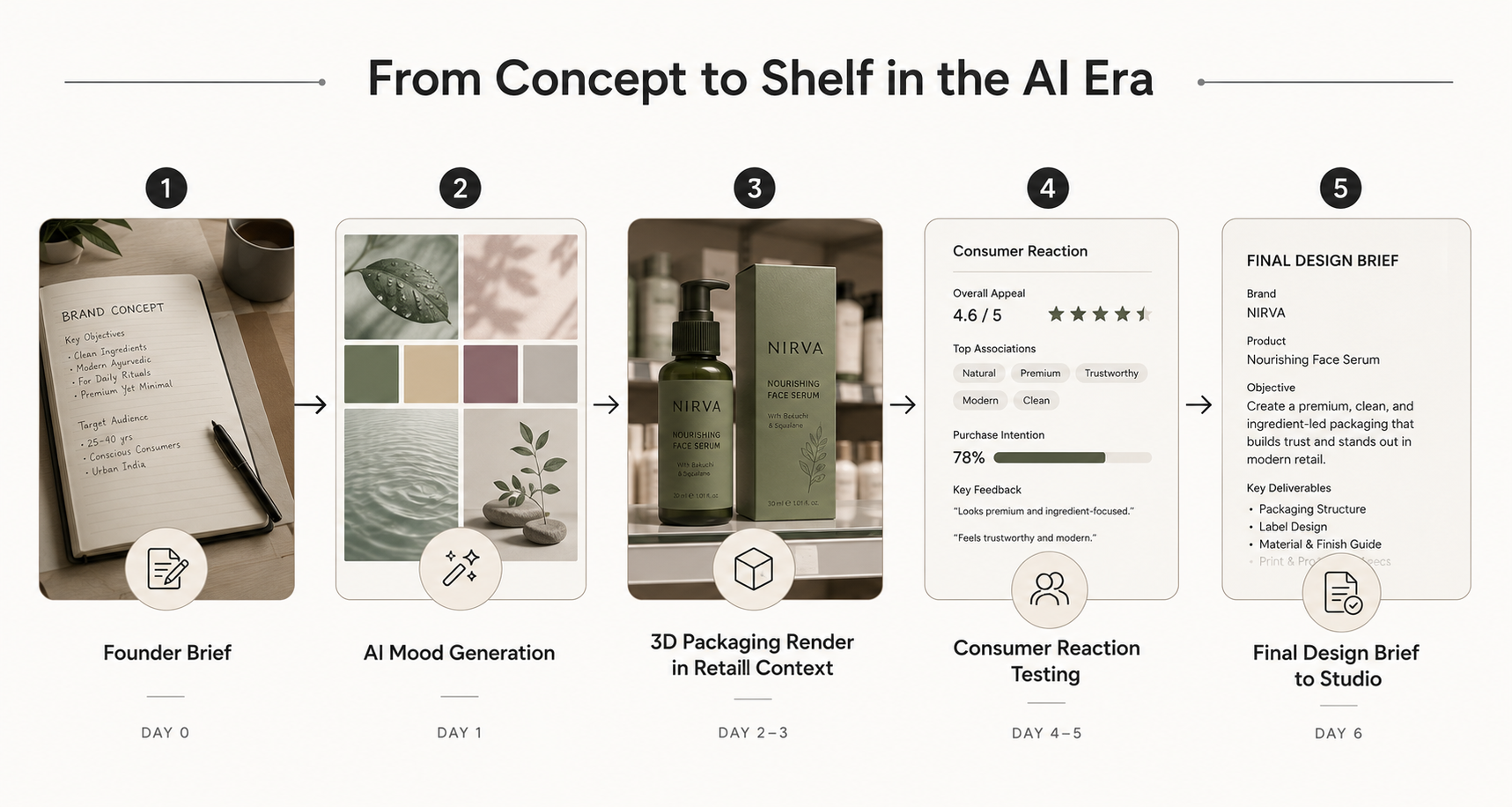
AI in branding and packaging design means using machine learning, generative models, and predictive tools to compress the time and cost of four specific tasks: visual concept generation, packaging prototyping, label copy creation, and consumer reaction testing. In 2026, these are not experimental applications. They are active parts of how fast-moving consumer brands in India, across skincare, snacks, and wellness, are reducing design cycle time and improving pre-launch decision quality.
The practical applications, in order of how founders are using them:
- Concept generation: Generating packaging mood directions and visual references in hours rather than weeks
- Prototyping: Producing photorealistic 3D packaging renders in retail environments before any physical prototype is made
- Copy generation: Creating label copy, naming options, and tagline variants at speed for testing
- Visual testing: Running simulated eye-tracking and attention analysis on packaging layouts before print
The question for founders is not whether AI belongs in the process. It does. The question is which parts of the process AI improves, and which parts still require strategic human judgment to get right.
See our guide to packaging design trends in India to understand how AI fits into the broader shift happening across Indian D2C retail.
Before reading further, name which of the four applications above your team currently has zero exposure to, since that is usually the easiest place to start.
5 AI Trends Reshaping D2C Branding and Packaging Right Now
1. Generative Visual Ideation
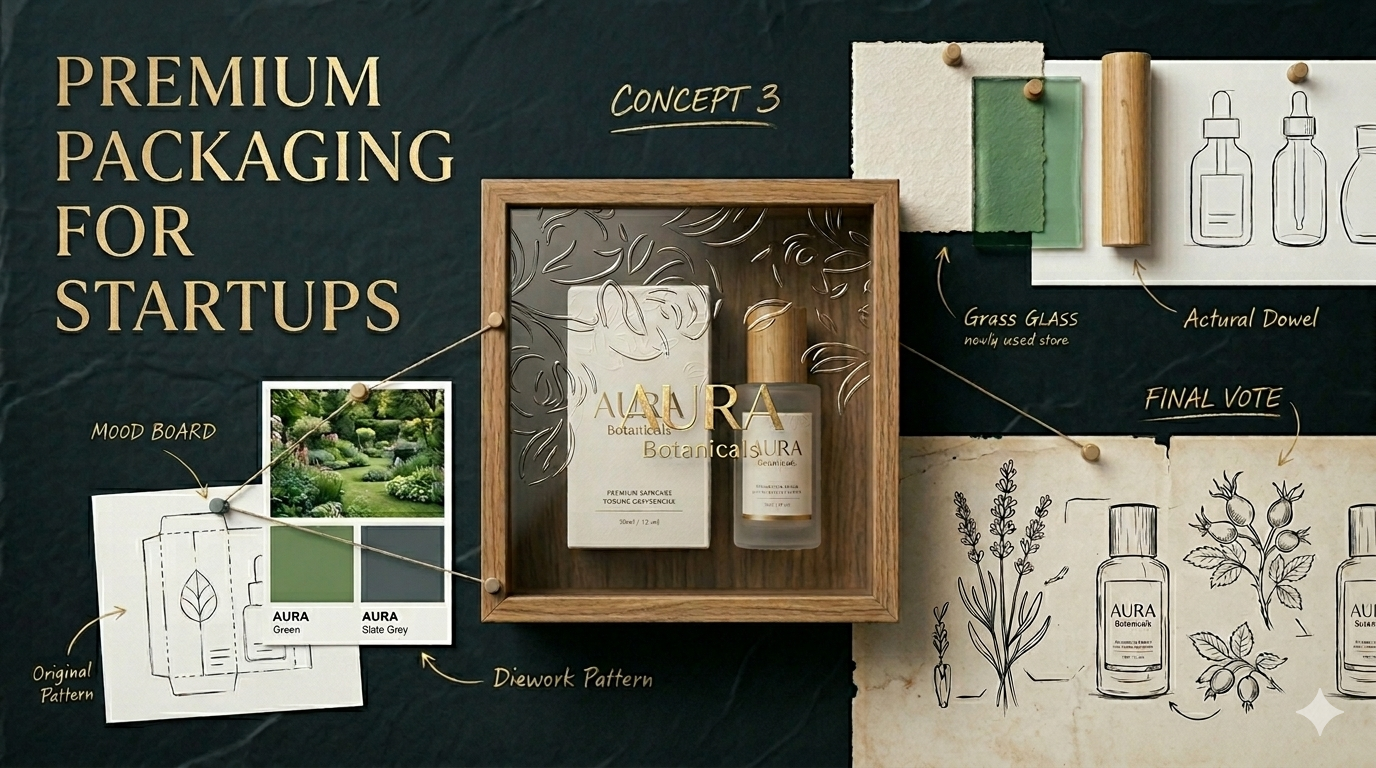
Generative AI tools such as Midjourney, Adobe Firefly, Canva AI, and Stable Diffusion have changed the early stage of brand design structurally. A founder can now prompt a tool to generate 40 packaging mood concepts in two hours, where what used to require a design team for a week now happens in a single afternoon. For D2C brands in skincare, wellness, and clean food, this is a genuine advantage: cheap iteration leads to better final decisions when the iteration is being filtered by someone who understands positioning.
The risk most founders underestimate: AI-driven design tools tend to converge toward the category average, since they are trained on existing design datasets, which means they reproduce what already exists more reliably than they create what does not. The most common AI packaging output for an Indian skincare brand is a clean white background, sans-serif typography, and botanical illustration, because that is what the training data reflects. That output looks "good," but it also looks exactly like dozens of your competitors.
The brands that use generative AI effectively treat it as an option-generation engine, not a decision-making one. Generate 30 concepts, then filter to 3 that break from the category default rather than reinforce it. That filtering is the positioning work, and it requires a human who understands what the category already looks like and where the gap is.
Founder action: Before prompting any AI tool for packaging concepts, screenshot the top 10 products in your category on Amazon or Nykaa. Use that as your "do not produce this" brief, telling the AI what you do not want, not just what you do.
See our guide to best branding examples for D2C brands to see how the best Indian D2C brands set visual benchmarks that AI has to work hard to match.
Run your own screenshot audit of the top 10 competitors in your category before your next AI prompting session, regardless of whether that category is skincare, snacks, or beverages.
2. AI-Powered Packaging Prototyping
3D rendering tools with AI capabilities, such as Packly, Esko, and similar platforms, now let brands preview packaging in photorealistic retail environments without a physical prototype. A brand building packaging for a skincare range can see how a 30ml serum bottle looks on a Nykaa shelf tile, in a Blinkit delivery thumbnail, and on a white ecommerce background, all before spending on manufacturing.
This is one of the clearest commercial applications of AI in packaging. The direct benefits are measurable:
- Faster stakeholder approvals: A photorealistic render reviewed by a retail buyer or investor communicates the design decision far more clearly than a flat 2D mockup
- Faster iteration cycles: Changes to typography, colour, or hierarchy can be tested visually in hours rather than waiting for physical samples
- Reduced production mistakes: Errors in proportion, label placement, or structural fit that would only surface in a physical prototype are now visible in the render stage
- Lower prototyping costs: Removing one or two physical prototype rounds reduces both cost and time to production
For any founder preparing packaging for a retail pitch or a significant production run, AI render tools are the most straightforward efficiency gain available in the current design process, compressing the gap between concept and a confident production decision.
For context on packaging validation before manufacturing, see our guide on best packaging styles for D2C brands.
If you have a retail pitch or a major production run coming up, request a 3D render in a retail-context setting before committing to a physical prototype, whether the product is a serum, a snack pouch, or a beverage bottle.
3. Personalised Packaging at Scale
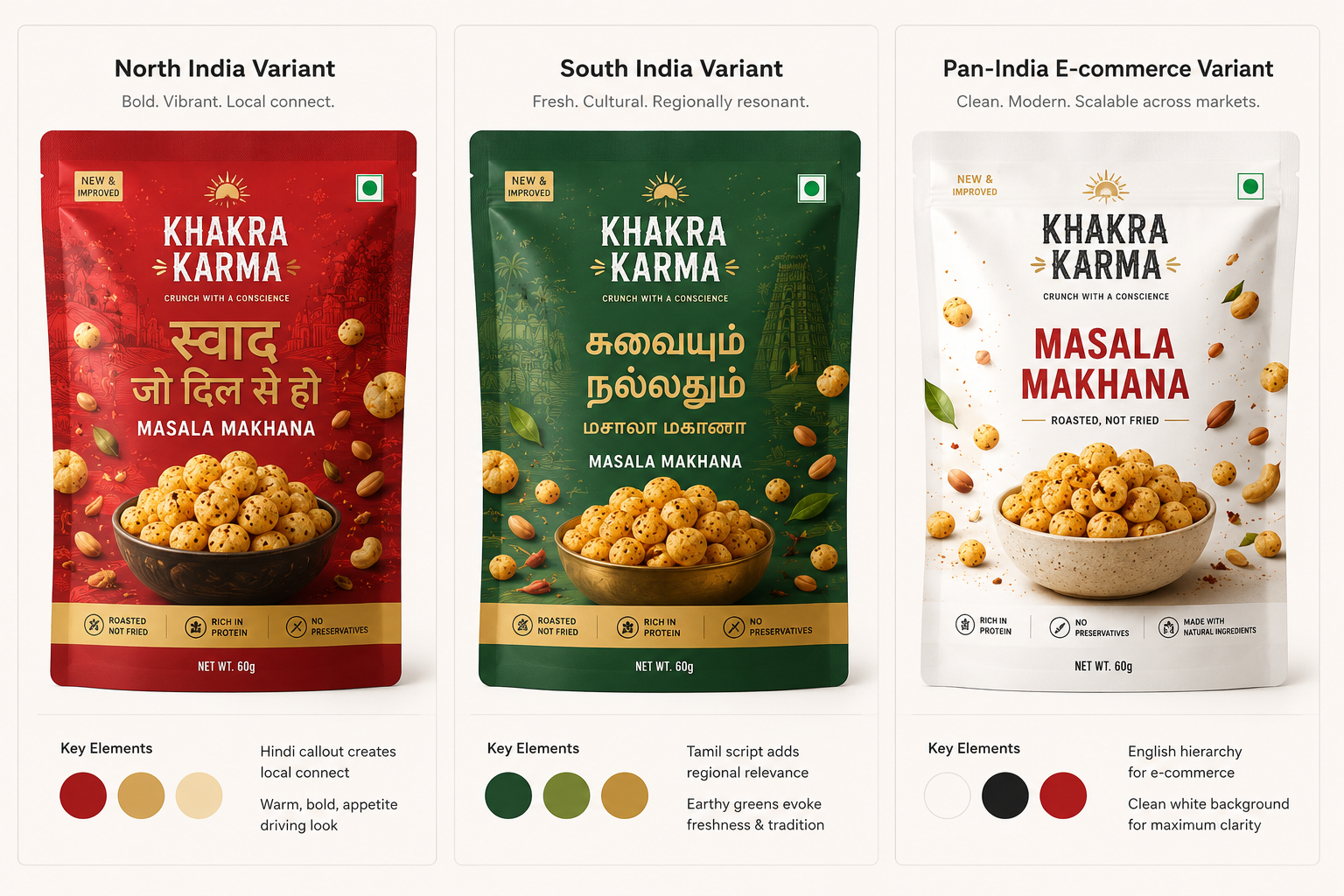
AI-powered variable data printing (VDP, a print technology that lets specific elements like text or imagery change automatically across a print run without a separate design file for each version) systems allow brands to create customised packaging variants for regional markets, seasonal campaigns, or limited-edition releases, without a separate full design project for each variant. The master brand structure stays consistent; specific visual and copy elements adapt to the context.
It is worth being clear about adoption levels: regional packaging personalisation at true scale is currently more common among larger FMCG (fast-moving consumer goods) brands with the production infrastructure to support variable print runs. For most early-to-mid-stage Indian D2C brands, the practical applications are more focused.
- Limited edition and festive packaging: AI tools can generate variant concepts for Diwali, Holi, or regional festival campaigns within a consistent brand system, significantly reducing the design sprint required
- Regional ecommerce merchandising: Adapting benefit callouts or claim language for different state-level audiences on BigBasket or Blinkit without rebuilding the full label
- A/B testing packaging variants: Generating two or three label variations for conversion testing on Amazon or Nykaa without commissioning multiple design projects
The underlying logic is sound even where scale is limited. A wellness brand with distribution across Tamil Nadu and Punjab does not necessarily need entirely different packaging, but benefit claims that land with a South Indian buyer may need to be framed differently than ones targeting a North Indian buyer, and the same logic applies to a snack or beverage brand expanding regionally. AI tools can adapt those specific elements while the master brand system holds.
See our guide to consumer psychology in packaging design to understand why regional personalisation goes beyond aesthetics: it directly affects purchase decisions.
If you sell across more than two regions, list one claim or callout per region that might land differently before commissioning any regional variant work.
4. Predictive Brand Testing Before Launch
AI-driven consumer testing platforms, such as Dragonfly AI, Designalytics, and eye-tracking simulation tools, allow brands to test packaging performance before a single unit ships. These tools simulate consumer visual behaviour, showing where the eye goes first on a shelf, which label elements are noticed within two seconds, and how clearly the product promise registers before the shopper moves on.
For those unfamiliar with eye-tracking simulation, these tools use AI models trained on large datasets of human visual attention patterns to predict, with reasonable accuracy, what a shopper will look at and in what order when encountering a new product. The output is typically a heatmap overlaid on the packaging design, showing which areas attract attention and which are ignored.
The metrics that matter:
- Attention: Which elements attract the eye first, and whether that matches your intended hierarchy
- Recall: Which claim or brand element a shopper remembers after a brief exposure
- Claim visibility: Whether your primary benefit claim is registering within the attention window a shopper actually gives a new SKU, typically 1.5 to 2 seconds in a retail context
- Product recognition: Whether the product category is identifiable within the first second without reading any text
The commercial case: For Indian D2C brands preparing for modern trade entry, such as D-Mart, Reliance Retail, or Nature's Basket, this kind of pre-launch testing reduces the risk of an expensive packaging mistake. A redesign after a failed retail listing costs significantly more than a testing session before the print file is finalised, and predictive testing identifies the hierarchy and visibility failures that are otherwise only discovered after production.
See our guide to how packaging design influences buying decisions to understand the psychology behind what these AI tools are measuring.
Before your next modern trade pitch, run your top SKU through a predictive testing tool and compare the resulting attention map against your intended hierarchy.
5. AI-Assisted Brand Naming and Copywriting
Tools like Copy.ai, Jasper, and Claude are being used by D2C founders to generate brand name options, tagline variations, and label copy at speed. A brand launching 12 SKUs simultaneously can generate 30 flavour description variants per SKU and pressure-test them in a week, work that would have previously required a naming agency several weeks to produce.
The speed advantage is real. The risks are equally real and less often discussed.
Trademark conflicts AI cannot detect: AI naming tools generate options without trademark database checks. A name that looks clear in English may conflict with a registered mark in a product category you did not think to search, and trademark risk increases for names that sound similar to existing registrations even when spelled differently.
Any AI-generated name shortlist needs legal screening before it goes on packaging.
Cultural nuance AI consistently misses: A name or tagline that works cleanly in English can carry unintended connotations when translated or interpreted in Hindi, Tamil, or Bengali. AI tools trained predominantly on English-language data do not reliably catch these conflicts, so "clean" naming in the English-language brief does not mean clean naming across the Indian languages your customer base actually speaks.
The correct sequencing: Use AI to generate options at volume. Use strategic judgment and legal review to filter to the three or four that actually hold the brand position, travel into modern trade, work phonetically across the primary languages of your distribution geography, and are clear of trademark risk. The selection decision earns more scrutiny than AI can apply.
See our guide to branding mistakes D2C startups make for the most common naming and positioning errors that no AI tool can prevent on its own.
Before locking any AI-generated name, run it through a trademark screen and a phonetic check in your top two distribution languages.
What Indian D2C Brands Are Doing Differently
The most effective Indian D2C brands are not choosing between AI and agency. They are sequencing them, using AI to operate at speed within a brand system that was built by designers and strategists, not generated by a prompt.
The pattern that holds across the Indian D2C category is consistent: AI operates within a strong brand system, and without that system, AI produces noise.
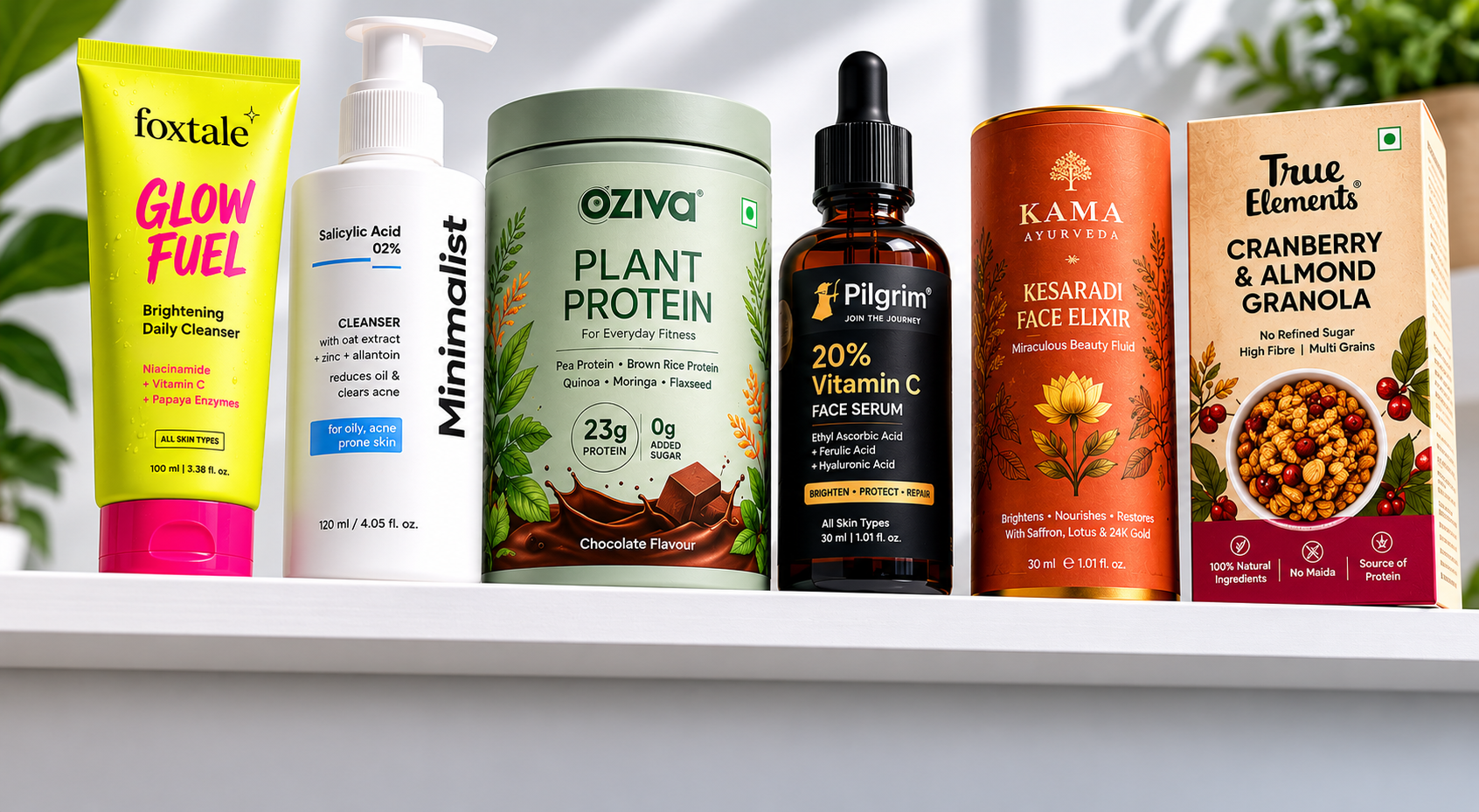
In the natural skincare category, brands that have built visual coherence at scale, with consistent colour systems, typography hierarchies, and photography direction across large SKU ranges, are increasingly using AI tools to maintain that coherence as the product range grows, without requiring a full design sprint for every new product image.
The brand system is the foundation; AI is the production engine that runs on top of it. In the functional food and nutrition category, brands with clear benefit positioning are using AI-assisted copy tools to adapt claim language for different fitness audiences and retail contexts, without rebuilding the label structure each time. The positioning is fixed, and AI adapts the expression of it.
In the skincare and wellness space, brands that iterate packaging concepts before major launches are using AI render environments to test new directions in realistic retail contexts before committing to production tooling. The aesthetic direction is decided by designers; AI compresses the time it takes to visualise it accurately.
The common thread: AI accelerates execution within a defined system. It does not replace the decisions that define the system.
This is why brand identity design services remain the strategic foundation: the thing AI accelerates but cannot replace. Identify which of the four category patterns above matches your business and note the one AI application listed for it that you have not yet tried.
What AI Cannot Replace in Brand Design
This is the part most AI trend articles skip. AI cannot do the following, not in 2026, not with the tools that exist today.
Brand strategy and category positioning. AI does not know what gap exists in your specific category in your specific price tier, and it does not know that an upscale position in Indian wellness means something different on Nykaa versus BigBasket versus a pharmacy shelf.
Strategy requires understanding the specific retail context, the specific competitor set, and the specific consumer behaviour at your price point. AI can surface information, but it cannot make the strategic call about where to position a brand relative to that information.
Consumer insight generation. The most important inputs to a branding decision, such as why a buyer in your category switches brands, what claim language actually builds trust, and what visual associations trigger a sense of personal recognition, come from qualitative consumer research that AI cannot replace. AI can process data, but it cannot conduct the interviews that produce genuine category insight.
Brand architecture decisions. When a brand moves from one product to a range, from one channel to several, or from one price tier to a higher one, the brand architecture decisions that follow, such as what stays consistent, what adapts, and what becomes its own entity, are strategic calls that require understanding the long-term commercial direction of the business. AI does not have that context.
Cultural nuance. A packaging design that works in Mumbai reads differently in Jaipur, and colours carry different associations across regional markets. AI tools trained on global design datasets are systematically biased toward Western aesthetic conventions, so the default output of most generative tools looks like it belongs in a Scandinavian pharmacy, not on a BigBasket category page.
Structural packaging design. The shape of a bottle, the material weight of a carton, the die-cut on a sachet are engineering decisions that affect shelf presence, logistics cost, and consumer experience simultaneously. AI does not design primary packaging structures; it decorates them.
Emotional resonance and brand voice. The reason a customer keeps buying a brand they trust is not the ingredient list, it is the voice: the on-pack copy that speaks to them as a person, not as a demographic. That voice is a human decision. AI can generate 50 tagline options, but choosing the one that builds the brand's long-term emotional position is strategy, not automation.
The closing point: AI can generate assets. It cannot decide what a brand should stand for. That decision is the one everything else builds on, and it requires the kind of strategic thinking that no tool in 2026 has replaced.
See our guide to storytelling through packaging design to understand how the best D2C packaging converts customers before the product is even opened.
See our guide to packaging psychology explained for a deeper look at why human-led design decisions still drive the strongest purchase triggers.
List the seven things above next to your own brand's current process and mark which ones are still genuinely human-led versus which have quietly drifted to AI-only.
How to Use AI Without Losing Your Brand Identity
A practical framework for D2C founders integrating AI into their branding and packaging process:
Step 1: Lock your brand system first.
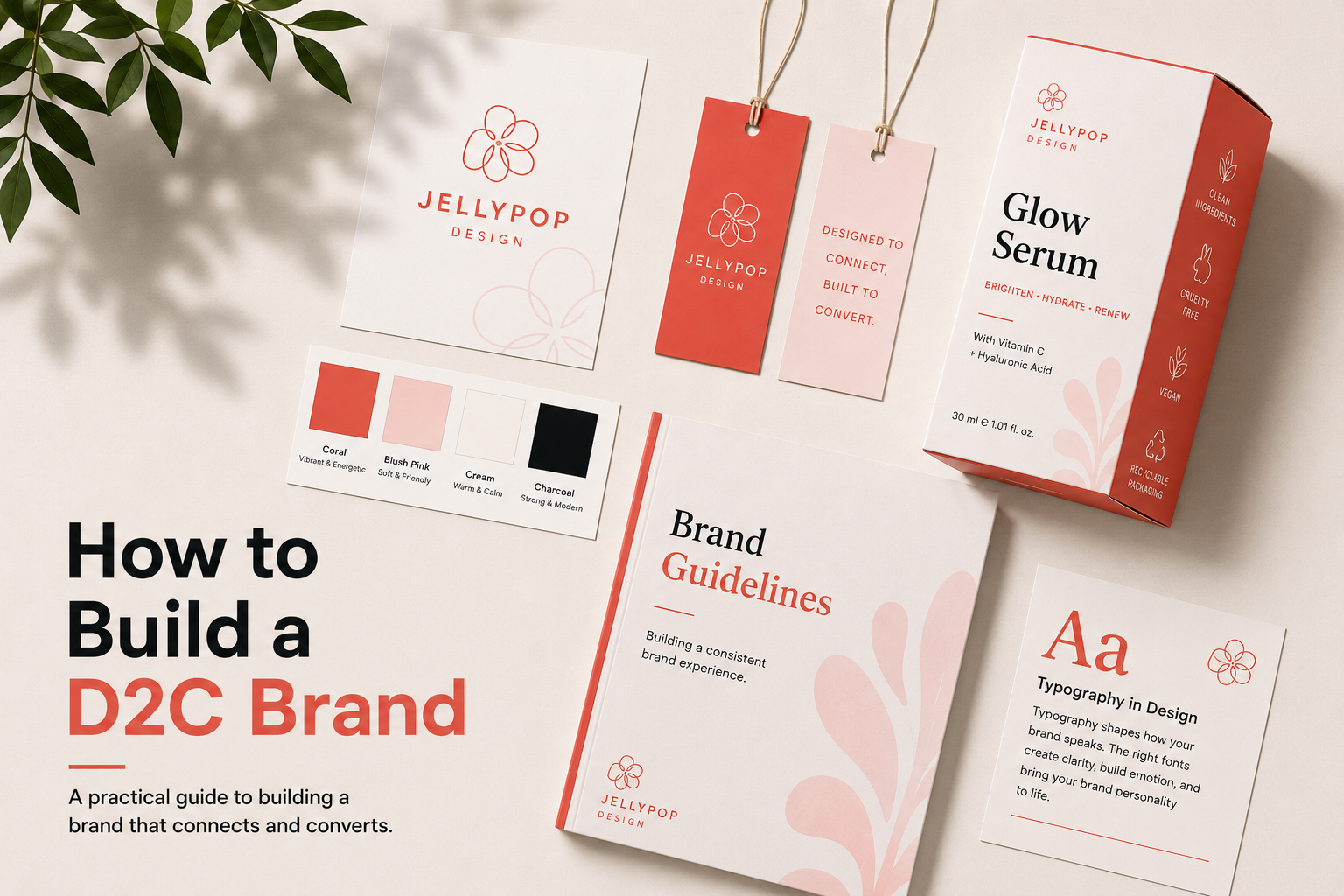
Colour palette, typography, tone of voice, logo, and structural packaging decisions must be defined by a human designer before AI touches anything. AI without a brand system produces generic outputs, while AI inside a strong brand system produces fast, on-brand options your team can actually use. If your brand system is not yet defined, that is the first investment to make.
Step 2: Use AI for quantity, human expertise for quality filtering.
Generate 30 options with AI, then have your designer or brand strategist filter to the 3 that actually hold the brand position. Never present an AI output directly to a manufacturer, retailer, or investor without design review, since the filtering is the work, and it is human work.
Step 3: Test everything in context.
AI render tools let you see packaging in realistic shelf environments. Use them, since a design that looks beautiful in Figma often fails when placed between two competitors on a Blinkit category grid or evaluated by a retail buyer under fluorescent lighting.
Step 4: Keep brand naming and positioning human-led.
Use AI to generate options at volume, then apply strategic judgment and legal review to select and refine. Your brand name will be on every SKU, every shelf talker, and every paid ad for years to come, and that decision earns more scrutiny than any AI tool can apply.
Step 5: Audit AI outputs for cultural fit.
Before locking any AI-generated visual, ask whether it looks like it was made for an Indian consumer, and whether a shopper in Chennai and a shopper in Chandigarh would both understand it. Confirm it holds up on a mobile screen, a retail shelf, and a courier box simultaneously.
Step 6: Create AI guardrails before your team uses any generative tool.
Without guardrails, AI tools used by different team members or different vendors will drift from the brand system in different directions. Build a short AI usage brief that includes:
- Approved colour palette with hex and CMYK values (and what not to generate outside these)
- Approved typography and typeface names (and which typefaces are off-limits)
- Tone of voice rules and examples of on-brand versus off-brand copy
- Visual system constraints (what imagery style is allowed, what is not)
- Packaging hierarchy rules (what element is always dominant, what is always secondary)
This brief takes a few hours to write. It prevents months of brand drift as AI tools become more embedded in the production process.
See our guide to D2C branding trends in India to understand how the broader Indian D2C landscape is evolving and where AI fits inside that larger shift.
If you are still defining what your brand stands for before adding AI to the mix, our brand identity design services give you the foundation that makes AI work properly.
See our guides to how to improve product shelf appeal and best packaging styles for D2C brands for context on what strong packaging systems look like before AI enters the workflow.
Write your AI usage brief this week, even a one-page version, before the next team member generates packaging concepts with an unguided prompt.